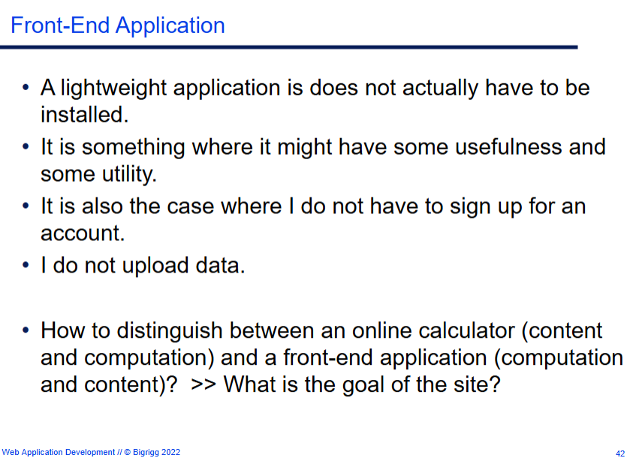
Now we have these lightweight applications that don’t need to be installed. One thing I like to point out is that I often talk about the calculator space. The reason for that is that a lot of applications can almost be thought of as calculators. You’re doing some computation—some programming—and getting a result.
Now, we’re going to go beyond just having programming as a feature. Our programming is going to support personalization and really turn the site into a product. But thinking in terms of a calculator is still helpful because it forces you to ask: what is the goal of the site?
If the goal is primarily content, then you might have calculators or bits of programming that reinforce that content. They make the site dynamic. They make it interactive. But the content is still the main thing.
On the other side, you may have an application where the computation itself is front and center. For example, a tool that lets me find keywords within a block of text. That’s a front‑end application. I don’t have to install anything—I just go to the website and use it. And that’s important, especially from a company perspective. Instead of asking, “What do I need to install?” the answer is, “Nothing. Just go to the site.”
Even in that case, though, there still needs to be some content. That content exists so people can discover the tool—so search engines can find it and send users there.
So this is where we start to see two uses of client‑side programming. In one case, the computation reinforces the content. In the other case, the computation is the product, and the content exists mainly to help people find it.